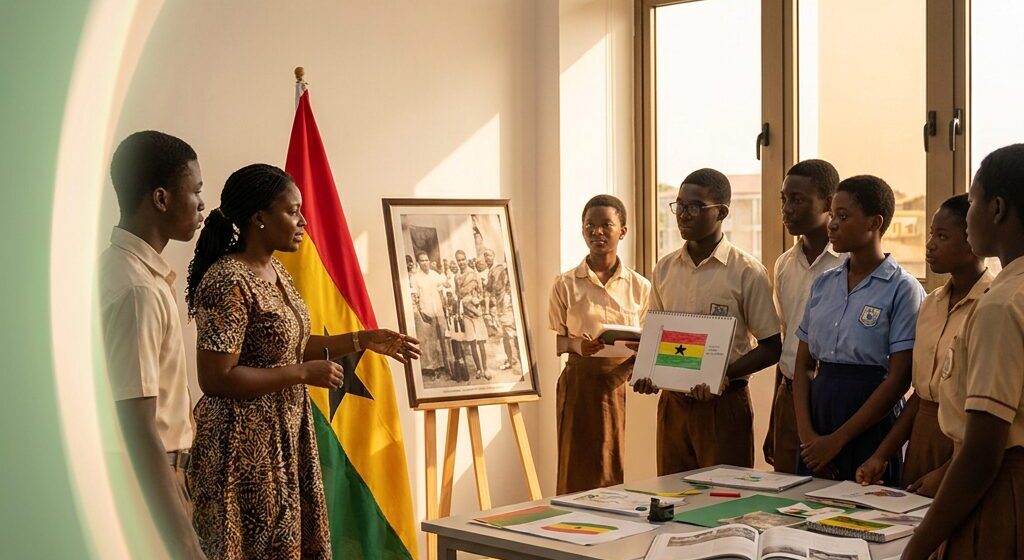
The Ghana flag is a horizontal tricolour of red, gold and green in three equal stripes, with a black five-pointed star in the centre of the gold stripe. It was designed by Theodosia Salome Okoh and first hoisted on 6 March 1957, when Ghana became independent. Its standard proportion is 2:3.
Updated October 2026
If you are printing a banner, finishing a school project or putting a national mark on packaging, a picture is not enough. You need the stripe order, the star placement, the ratio and the colour values together, in one place you can work from.
What does the Ghana flag look like?
The design is a horizontal tricolour. Red sits at the top, gold (often described as yellow) in the middle and green at the bottom, in three stripes of equal height, with a black five-pointed star in the centre of the gold stripe[1]. In the standard drawing the star is centred and its points reach the top and bottom edges of the gold stripe[2,3].
Many writers say yellow rather than gold. Both words describe the same middle band, so do not look for a fourth colour. The flag uses three colours plus a black star, laid out as horizontal bands in a 2:3 shape[2]. A version with vertical bands or a white star is not the flag of Ghana.
Descriptions that are wrong, and why
- Vertical stripes: the bands run across the flag, not down it.
- A white middle stripe: that was the 1964 to 1966 version, not the current flag[4].
- Unequal stripes: all three bands are the same height.
What does each band and the black star stand for?
Ghana’s diplomatic missions give the official explanation of the colours[1]. Red stands for the revolutionary spirit and the sacrifice of those who died in the struggle for independence. Gold was inspired by the mineral wealth of Ghana’s land, the country formerly called the Gold Coast. Green represents the forests, vegetation and natural resources that also support the country’s agriculture and agribusiness. The black star, described as the lone five-pointed star, is the symbol of African emancipation and of unity in the struggle against colonialism.
The black star is also widely linked to the Black Star Line, the shipping company founded by Marcus Garvey, and it gives Ghana’s national football team its nickname, the Black Stars. Red, gold and green are the Pan-African colours first used on Ethiopia’s flag; Flags of the World notes that Ethiopia’s green, yellow and red, together with the colours of the Convention People’s Party, inspired Ghana’s flags[2].
The three bands at a glance
| Element | Position | Stated meaning |
|---|---|---|
| Red | Top stripe | Blood and sacrifice of those who fought for independence |
| Gold (yellow) | Middle stripe | Ghana’s mineral wealth |
| Green | Bottom stripe | Forests, vegetation and natural resources |
| Black star | Centre of the gold stripe | African emancipation and unity against colonialism |
Who designed the Ghana flag and when was it adopted?
The flag was designed by Theodosia Salome Okoh to replace the British Union Jack when the Gold Coast became independent as Ghana[1,5]. It was first hoisted on 6 March 1957, when Ghana became the first country in sub-Saharan Africa to gain independence from colonial rule[1,6].
Graphic Online records that Mrs Okoh was born at Anum, in the Eastern Region, on 14 June 1922, and died at Narh Bita Hospital in Tema on 19 April 2015, aged 92[5].
Was there an old Ghana flag?
Yes. From 1 January 1964, after Ghana became a one-party state under Kwame Nkrumah’s Convention People’s Party, the gold middle stripe was replaced with white, a feature of the party’s own flag[4,6]. That red, white and green version, still with the black star, was used until 28 February 1966, when the original red, gold and green flag was restored after Nkrumah was overthrown[4]. The flag in use today is the 1957 design.
What specification should designers use?
Use this block when you print, cut vinyl, embroider or build a web graphic.
| Element | Specification |
|---|---|
| Proportions | 2:3 (height to length)[2] |
| Stripe order | Red over gold over green, three equal stripes[2,3] |
| Star | Black five-pointed star centred on the gold stripe, its points reaching the top and bottom of that stripe[2,3] |
| Colour values (approximate) | No official specification found. Commonly used: #CE1126 red, #FCD116 gold, #006B3F green, #000000 black[3] |
Flags of the World contributors report finding no legal document that specifies the flag’s design or colours, and note that Ghana’s Constitution does not describe it; other references list slightly different values[2]. Treat the hex codes above as approximations. For government work, uniforms or public monuments, ask the commissioning office for its approved swatches before you print.
A worked example for a banner
Say you order a banner three metres long. A 2:3 ratio means the height is two thirds of the length, so 3 x 2 / 3 = 2 metres tall. The three stripes must be equal, so 2 / 3 = 0.67 metres for each band, and the black star is drawn so its points reach the top and bottom of that middle band. Ask for a printed proof and check that the gold has not drifted towards mustard or the green towards a flat mid-green. If you need a supplier, see our directory of media, advertising and printing companies.
How does Ghana’s flag differ from similar flags?
Ghana shares its colours with several African flags, and mix-ups are common in slides and signage. Two checks settle it quickly. First, direction: Ghana’s bands run horizontally, so a vertical tricolour is never Ghana. Second, the emblem: Ghana’s star is black and sits on the yellow middle stripe.
| Flag | Band direction | Emblem |
|---|---|---|
| Ghana | Horizontal red, gold, green | Black five-pointed star on the gold band |
| Senegal | Vertical green, yellow, red | Green star in the centre band |
| Ivory Coast | Vertical orange, white, green | No emblem |
| Togo | Horizontal stripes with a red canton | White star in the canton |
| Burkina Faso | Horizontal red over green | Yellow star in the centre |
| Ethiopia | Horizontal green, yellow, red | Blue disc with a yellow emblem |
Which Ghana flag images and png files may you use?
For a ready-made file, Wikimedia Commons hosts the flag as an SVG (File:Flag of Ghana.svg) marked as public domain, and it can be exported to PNG at any size[3]. Commons also warns that national symbols can carry legal restrictions on use that are separate from copyright, so the public-domain tag covers copying the file, not every commercial or official use. Do not copy flag photographs from stock libraries or image searches without a licence: a photograph is a separate copyright work.
You can also draw a flat vector yourself from the specification above: build the rectangle at 2:3, set three equal stripes, place the black star with its points touching the edges of the gold stripe, then apply the colour values your brief or printer approves.
How to choose the right flag file
- Printing large, cutting vinyl or embroidering: use a vector file built to the 2:3 proportion, never a screenshot.
- Web, slides and social posts: a PNG exported from the public-domain SVG is fine, provided the ratio is right.
- News article, blog or report that needs a real scene: licence an editorial photograph from a stock library and credit it.
- Commercial packaging or signage: check with the commissioning office or your regulator whether the flag may appear as you intend, before artwork is approved.
A quick check before you print
Open the flag file you already use and run four checks: the 2:3 ratio, three equal stripes in red, gold, green order, a black five-pointed star that reaches the top and bottom of the middle band, and colours that match your approved swatches. Fix whatever fails, save it as a master vector, and brief your printer with the ratio and swatches in writing.
Frequently asked questions
What do the three colours of the Ghana flag mean?
According to Ghana’s diplomatic missions, red stands for the sacrifice of those who died in the struggle for independence, gold for the country’s mineral wealth, and green for its forests and natural resources. The black star is the symbol of African emancipation and unity against colonialism[1].
What colours are on the Ghanaian flag?
Four colours appear: red, gold (often called yellow), green and black. The red, gold and green run as three equal horizontal stripes, with a black five-pointed star in the centre of the gold stripe[1,2]. Anything with vertical stripes or a white star is not Ghana’s flag; a white middle stripe was used only from 1964 to 1966[4].
What is the official ratio of the Ghana flag?
The flag is normally made in the proportion 2:3, height to length[2]. So a flag three metres long is two metres tall, with each of the three stripes the same height. No published legal specification has been found, so for an official commission ask the ordering office to confirm its measurements before production.
Which hex colours should designers use for the Ghana flag?
There is no official colour specification on record[2]. A commonly used set is #CE1126 red, #FCD116 gold, #006B3F green and #000000 black, the values in the Wikimedia Commons flag file[3]; other references give slightly different codes. Treat them as approximations and, for government work, uniforms or monuments, proof against the swatches the commissioning office approves.
Where can I get a Ghana flag png or image?
Use the public-domain SVG on Wikimedia Commons (File:Flag of Ghana.svg) and export a PNG at the size you need[3]. Use of a national flag can still be restricted by law, independent of copyright, so check before putting it on commercial products. Flag photographs from stock libraries are copyrighted and need a licence.
How is the Ghana flag different from the Senegal flag?
Ghana’s stripes run horizontally in red, gold, green order with a black five-pointed star on the gold band. Senegal’s stripes run vertically in green, yellow, red order with a green five-pointed star in the centre of the yellow stripe[7]. So check direction first, then the star colour. The same two checks separate Ghana from Togo, Burkina Faso and Ethiopia.
Sources
- Embassy of Ghana, Ankara – National Emblems (checked 19 Oct 2026)
- Flags of the World – Ghana (checked 19 Oct 2026)
- Wikimedia Commons – File:Flag of Ghana.svg (checked 19 Oct 2026)
- Flags of the World – Ghana, 1964-1966 flag (checked 19 Oct 2026)
- Graphic Online – Theodosia Salomey Okoh: Gone home (20 Apr 2015)
- Encyclopaedia Britannica – Ghana (checked 19 Oct 2026)
- Flags of the World – Senegal (checked 19 Oct 2026)